Tuesday, January 29, 2013

The Leadership Pipeline Model

Developing Your Organization's Future Leaders

Imagine that several mid-level managers in your organization are planning to retire in the next few months, and, as a result, you're facing a serious staffing problem.

Do you start searching outside your organization, or should you focus on finding people from within the company, so that you can quickly train them for these positions?

Many organizations spend a lot of time searching for good people for their leadership teams. It's often most efficient to promote from within, as internal people are "known quantities," and are already familiar with how the company works.

However, many organizations don't have a process in place for "growing their own leaders," so they need to search for outside talent to bring in.

In this article, we'll look at the Leadership Pipeline Model, a tool that helps you plan for internal leadership development. We'll then look at how you can apply this model to your organization.

About the Model

Ram Charan, Stephen Drotter, and James Noel developed the Leadership Pipeline Model, based on 30 years of consulting work with Fortune 500 companies. They published the model in their 2000 book, "The Leadership Pipeline," which they revised in 2011.

The model helps organizations grow leaders internally at every level, from entry level team leaders to senior managers. It provides a framework that you can use to identify future leaders, assess their competence, plan their development, and measure results. Put simply, you can use the model to think about how you'll train your people to take the next step up the leadership ladder.

According to the model's developers, leaders progress through six key transitions, or "passages," in order to succeed. These six leadership transitions are show in Figure 1, below.

Figure 1 – The Leadership Pipeline Model
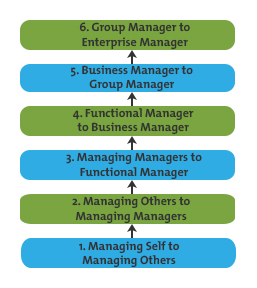
Leadership Pipeline

Each leadership stage needs different skill-sets and values, and, at each transition, leaders have to develop these in order to lead successfully.

According to the model, senior leaders in the organization should mentor more junior managers through each leadership transition, to ensure that they're using the appropriate skills for their current level. Staying "stuck" without the right skills, even if the manager progresses upward, can cause leaders to stagnate, become ineffective, and, ultimately, fail.

Uses of the Model

There are several benefits of using the Leadership Pipeline Model.

First, promoting leaders from within is better than searching for outside talent. These outside leadership stars often flit from one organization to the next, looking for the best opportunities, and leaving the organizations they have finished with to fill the gaps. The model's "pipeline" ensures that organizations have a steady stream of internal candidates qualified for open leadership roles.

The Leadership Pipeline encourages leaders to develop new skills and mind-sets for leading at the next level, rather than reverting to those used at the previous level, and this increases their flexibility and effectiveness.

If an organization's culture focuses on developing existing employees, this can raise the morale of the entire workforce. When people see opportunities to advance, staff turnover goes down and productivity and engagement go up. Furthermore, the investment in development pays off, because professionals stay with the organization longer.

As well as being useful for organizations that want to develop the next generation of leaders internally, this model is also helpful for planning your own career trajectory. Because you can identify the skills and approaches that you'll need for each transition, you can start to prepare yourself for your next promotion.

Applying the Model

Let's look at the six transitions in the Leadership Pipeline Model, and discuss how you can prepare people to make these transitions successfully.

1. From Managing Self to Managing Others

When someone is transitioning from working independently to managing others, a significant change in attitude and skill set must take place. The new leader is now responsible for getting work done through others รข€" a drastically different style of working.

To manage others successfully, these leaders must share information, offer autonomy, be aware of people's needs, and provide direction.

Navigating This Transition

Organizations need to make sure that first-time managers understand what's required of them.

New leaders need to focus on their communications skills, and communicate effectively with their teams. Partly, this involves communicating clearly in writing, but it can also be as simple as making time for subordinates to discuss their concerns. They need to know how to plan short- and long-term goals, define work objectives, and manage conflicting priorities.

New managers must also focus on their team members' needs. Coach new managers to practice Management by Wandering Around, which helps them stay in touch with their people. Encourage them to provide feedback, so that everyone on the team can improve.

It's important for new managers to know how to delegate effectively. At this level they're responsible for other people, and, if they can't delegate, they'll be harried, overworked, and stressed. This will also harm your organization's ability to get work done quickly.

Last, if you're coaching new managers through this transition, make sure that you monitor their progress to help them navigate the process successfully. Sit in on their interactions with direct reports, consider using 360° feedback to see how others view their abilities as a manager, and help them address any issues that arise.

2. From Managing Others to Managing Managers

This transition often presents a dramatic jump in the number of hands-on professionals that the manager is responsible for, which means that a number of new skills and working values are needed.

Navigating This Transition

First, new managers at this level need to know how to hold level one managers accountable. This might include becoming a coach or mentor to help them develop, and providing appropriate training. Managers in level two are also responsible for training the managers in level one, so make sure that they're aware of available training resources, and ensure that they know how to develop effective training sessions.

At level one, new managers might know how to get people to work together to accomplish a goal. But, at level two, managers must have the knowledge and skills needed to build an effective team.

Finally, these managers need to know how to allocate resources to the people and teams below them. These resources could be money, technology, time, or support staff, and they need to know how to budget effectively. They must know how to identify teams or units that are wasting resources, as well as knowing where to apply additional resources to improve performance.

3. From Managing Managers to Functional Manager

Functional managers often report to the business's general manager, and they are responsible for entire departments, such as manufacturing or IT. Making a transition to this level requires a great deal of maturity, and the ability to build connections with other departments.

Navigating This Transition

Functional managers must learn how to think strategically and manage with the entire department, or function, in mind.

Leaders at this level must know how to think over the long-term, as they'll need to plan for the medium-term future. They must also understand the organization's long-term goals, so that their functional strategy aligns with these aims.

Coach new functional managers to stay up-to-date on industry trends, so that they can take advantage of new advances: managers who are aware of technology and trends can adjust their strategy to better contribute to the organization's competitive advantage.

Although all managers need to be good listeners, this skill is particularly important at functional manager level. Teach your functional managers how to use active listening skills. They also need to be skilled at reading body language, so that they can avoid misinterpretation and spot untruths.

4. From Functional Manager to Business Manager

This transition may be the most challenging of the six leadership passages, because these professionals have to change the way that they think. When you're managing a business, complexity is high, the position is very visible, and many business managers receive little guidance from senior leaders.

Business managers oversee all of the functions of a business, not just one, and this requires a shift in values and perception.

Navigating This Transition

New business managers have to adjust their thinking to focus on future growth in all areas of the organization. They need to understand each function of the organization and know how these functions interrelate. Without this understanding, business managers will likely only focus on one or two functions, which could damage the organization's growth.

Encourage new business managers to get to know their functional managers well – for example, by talking with them and taking them on important trips; this will allow them to get to know the decision makers in each function and help them understand each function's value to the organization.

This group needs to know about the organization's core business processes, and understand where the profit lies within these processes. Without this knowledge, business managers can make costly strategic mistakes.

Last, and this isn't as trivial as it may seem, business managers need excellent time management skills. Managers who lack these skills won't spend enough time on key projects or with key people, so make sure that this group knows how to focus on important, not just urgent, tasks.

5. From Business Manager to Group Manager

To be a successful group manager, another subtle shift in skills must take place. At this level, managers are responsible for individual businesses which are often dispersed around the world. They must have the ability to get these businesses working together to accomplish the broader organization's long-term goals and objectives.

Navigating This Transition

Group managers need the ability to value others' success, and they must be humble enough to help others succeed. They need to learn how to critique the business managers' strategy-formulation, and provide effective feedback.

Group managers should know how to create the right mix of investments in their businesses to help the organization succeed. Resource allocation, market prediction and segmentation, and global business etiquette are all important skills here.

They also need to stay on top of all of their businesses to ensure that they're obeying the law, sticking to corporate policy, acting in a way that's consistent with corporate strategy, enhancing the global brand, and making a robust profit.

The businesses in their group that show the most promise in all these areas are the ones that will be fully funded. So, group managers must know how to maintain good relationships with businesses, even if they aren't getting the funding they want. They also need analytical skills in order to balance what's good for their businesses, versus what's good for the organization.

6. From Group Manager to Enterprise Manager

The enterprise manager, or CEO, is on the final rung of the career ladder for managers. This is the most visible position in the company; after all, if the CEO fails, it influences how people perceive the organization.

Navigating This Transition

Future CEOs need to understand that once they ascend to this level, they're responsible for a number of different stakeholder groups and organizations, such as the board, financial analysts, investors, partners, the workforce, direct reports, and local communities. Failing any of these groups means a loss of credibility.

By the time that managers reach this stage, they should already have developed many of the leadership skills mentioned in this article. However, there are several ways in which they can develop further. Our article on Level 5 Leadership teaches good leaders how to become great leaders by developing humility.

Often, CEOs, because of their number of responsibilities, have to make good decisions under an incredible amount of pressure. Make sure that potential leaders are familiar with a wide range of decision-making techniques, and know how to think on their feet.

Last, risk taking is a given at this level, but future CEOs need the courage to take calculated risks, even when they face opposition from others. This requires character, integrity, decisiveness, and inner strength.

Key Points

Ram Charan, Stephen Drotter, and James Noel developed the Leadership Pipeline Model and published it in their book, "The Leadership Pipeline." The model highlights six progressions that managers can go through as they develop their careers.

These progressions are from:

  1. Managing self to managing others.
  2. Managing others to managing managers.
  3. Managing managers to functional manager.
  4. Functional manager to business manager.
  5. Business manager to group manager.
  6. Group manager to enterprise manager.

While organizations can use these progressions to help develop their people, individuals can also use them to grow personally, increasing their knowledge and skills so that they're ready for their next promotion.


Monday, January 21, 2013

10 Management Don'ts

In addition to our formal education and training, we learn a lot about management on the job. We watch our mentors and our bosses to understand the "right" way to do things. Whatever our experiences in the trenches, they will likely shape the practices we employ at work—some good, some maybe not so good.

Regardless the size, industry, or specific corporate culture of your business, if you want to succeed as a manager, you should strive to avoid the following "management no-nos"—10 things a manager should never do.

Management Don'ts

1. Don't create a policy every time somebody messes up.
People make mistakes. Don't overreact. Sometimes people make big mistakes—like getting distracted on the Internet when a friend sends a link to an online game or accidentally hitting "reply to all" when sending an icy e-mail. It's usually a one-time goof-up. Get over it.

You don't have to build another wall around Fort Knox just because somebody accidentally took a paper clip home. Have a productive one-on-one conversation about what went wrong, what problems it caused, what the individual should have done (or not) and why. Use questions to make it a learning moment for the employee so that he or she can figure out how to fix it.

2. Don't lie. In other words, don't distort the truth, withhold information, or make things up—even if it's for a good reason. Strive for transparency: if you keep employees in the dark they won't trust you. When something isn't working out, say so. When things are going well, let people know. When you have concerns, share them. When you need something done by next week and you're worried it won't get done, discuss the situation with your staff. Keep them apprised of everything going on, within legal and privacy parameters. Have the difficult conversations and be straight with people about what's on your mind. Just don't try to manipulate people to control their behaviors or feelings.

3. Don't hide behind policies or senior management when you have to be tough. If an organizational policy makes sense, stand by it and explain why. If you believe something is unreasonable or unwarranted, say so. If you feel an employee's request for an exception is reasonable, go to bat for him or her. If you don't think the point is worth the battle, explain why you feel that way. Take a stand, provide the reasons behind your decision, then stick by it.

4. Don't spy on your employees. Don't keep close tabs on them by using cameras, special computer equipment, or by following them around to make sure they're doing what they're supposed to be doing and not violating any policies. Teach and nurture principles of commitment and trust. Deal with violations, but don't throw everyone into jail just because there's a possibility someone might make a bad decision or because of a past problem.

5. Don't be a pest. Don't delegate minor tasks and then micromanage the person by constantly looking over his or her shoulder, and don't be in a rush to take away responsibilities as soon as there's a problem.  Instead, empower people to succeed. Delegate broader responsibilities while providing clear direction and training on the "how," "what," and "why." Help people develop personal accountability.

6. Don't threaten people. Using threats and intimidation in any form is a sign of a weak leader. An effective leader knows how to build team and individual commitment by creating a positive work environment that invites people to engage with energy and purpose. You can discuss employee accountabilities and consequences, both positive and negative, without making threats.

7. Don't demand the impossible. Don't force your staff to do a physically impossible task just because your unreasonable boss pushed it onto you. Find ways to manage the demand by negotiating with your boss and committing to appropriate outcomes. Then provide the resources and support your staff needs to meet and even exceed commitments.

8. Don't ask employees to do anything unethical. Don't put people in situations where it's hard for them to do the right thing. Never ask them to do shoddy work, ignore a defect, fudge a report, or mislead others. Stand by your employees. Believe they want to do excellent work and to feel good about the organization. Be principled and committed to the greater good.

9. Don't make people choose between their families and the jobs. Don't be inflexible when it comes to sick leave and other HR policies. When you refuse to be flexible, don't be surprised when people violate policies. Instead, find a way to inject common sense and humanity into decisions about time off. If an employee was especially close to a deceased relative, give the employee the same consideration for attending an out of town funeral as you would if it were for the employee's parent. If an employee just joined the company, let him be at the hospital when his baby is born without having to worry about losing his job.

10. Don't ask for a lot more than you give. For example, don't beat up the employee who worked through the night to finish a project on time when she comes in a few minutes late. If you want strict start and stop times, make that clear and enforce it on both ends. If you want employees to step up, take responsibility for achieving organizational goals, and work late to get things done, don't nitpick about start times. Instead, have a conversation about what's really important, how start times support it, and what time commitments and expectations are necessary and relevant.

Trying it on for fit:
—Review the list of no-nos and determine where you stand as a manager

—Designate those you definitely don't do and give yourself a "smiley face" for each.

—Mark those you definitely or partially do with a frown face and think about why you do them.

—Make an action plan for changing each frown on your list into a smile. If your reasons for committing a no-no behavior are due to company policies or leadership's expectations, make a plan to request a change or exception to those policies. If your actions are simply the result of a practice you picked up from a previous boss, or something you developed on your own, develop a plan for changing the behavior.

—Even better, ask employees for input on what they would like from you instead.

©2011 Ascent Management Consulting, Ltd.  All Rights Reserved. Used with permission.

About the Author:- Kevin Herring is founder and president of Ascent Management Consulting. 

Thanks to Kevin Herring / AMANET / AMA—American Management Association
http://www.amanet.org/training/articles/10-Management-Donts.aspx?pcode=XA9U&CMP=NLC-MovingAhead2010&wm_tag=email&spMailingID=4375121&spUserID=NzQ2ODgwMDYxNwS2&spJobID=131491418&spReportId=MTMxNDkxNDE4S0


Monday, January 14, 2013

Minimizing Work Space Stress

Creating a Comfortable and Healthy Work Environment

Ling has just moved into a new office. Unfortunately, it isn't a comfortable space – the lights are too dim, the air is chilly, and she's regularly distracted by her colleagues' loud conversations. She has to commute much further to the new office, and often arrives feeling tired, stressed, and irritable.

After a few weeks, Ling realizes that her stress levels have increased, and that her productivity has dropped. She is also more irritable with her team and with her family at home.

After meeting with her boss to discuss the problem, they agree to make several small changes to her office. Now, her work space is well-lit and inviting, and the air is warm and comfortable. Ling is now able to telecommute two days a week, and, while she can still hear telephones and her colleagues' conversations when she's in the office, she listens to "white noise" through her headphones and is rarely interrupted by these sounds.

No matter what you do or where you work, it's likely that you'll have experienced environmental distractions during the day. If unaddressed, these can contribute to the levels of stress you experience. In this article, we'll look at some common sources of work space stress, and we'll discuss strategies that you can use to reduce their impact.

Where Does Work Space Stress Come From?

Work space stress can come from any physical conditions that you perceive as irritating, frustrating, uncomfortable, or unpleasant. Sources of work space stress include the following:

  • Poor lighting.
  • Loud background noise, such as music, traffic noise, or conversation.
  • Chairs or desks that cause discomfort, or even repetitive strain injuries (RSI).
  • Unhealthy air, such as air pollution, smoke, or unpleasant smells.
  • Overcrowding, or workstations in close proximity to others.
  • Long, difficult, or crowded commutes.
  • Uncomfortable climate conditions, such as an office that is too hot, too cold, too humid, or too dry.
  • An unclean or cluttered office space.

Some of these are quite small things, but, taken together, they can significantly contribute to the stress that people experience.

How to Manage Work Space Stress

There are several things that you can do to lessen or eliminate sources of stress in your workplace. While you can make some of these changes on your own, you might need your boss's permission for others.

1. Reduce Office Noise

Noise is a harmful sources of stress. People often cite background noise, or a lack of sound privacy, as the most distracting element in work environments. One study found that office noise, particularly telephones ringing at empty desks and loud conversations, impaired worker concentration. Another study found that workers experienced a drop in motivation and in their ability to solve problems when exposed to low-intensity office noise.

You can reduce noise pollution in your work area in several ways.

First, consider closing your office door when you need to focus. A closed door helps you to minimize distractions, both audible and visual. However, if your organization has an "open door" policy, or if you work in a cubicle, this won't be an option.

Consider using headphones while you're working. Listening to music, especially classical or ambient music, will eliminate distractions and can improve your concentration. Alternatively, you can play audio tracks of waterfalls, birds chirping, or white noise to reduce the distraction of background noise.

If you work in an open office, ask your boss about installing noise screens. These block and absorb background noise and create a quiet space. You can also use carpets, rugs, or fabric on surfaces and walls to absorb sound.

Plants are an important addition to any office. Not only do they reduce air pollution and add oxygen to the atmosphere, but they also reduce background noise. Some plants, such as peace lilies or weeping figs, are more effective for dampening noise than others. Place plants around the edges or corners of a space for the best sound dampening effect. You'll notice a bigger difference if you use several smaller arrangements in a space, rather than one big cluster of plants.

If your colleagues regularly play music or talk loudly on the phone, ask them politely and assertively to be quieter. Keep in mind that any noise you make in your office might be a source of environmental stress for someone else, so do your best to work quietly.

2. Create a Healthy Workstation

You may spend much of your day sitting at your desk in front of a computer. This is why it's so important that your chair, desk, and computer are at the correct height and angle.

When these tools are routinely out of alignment, you might suffer from repetitive strain injury. This potentially serious condition occurs when you engage in prolonged, repetitive movements such as typing, clicking a mouse, or writing. RSI can result in damage to muscles, tendons, and nerves in the neck, shoulders, wrists, or hands.

Good posture at your desk is an important part of reducing or eliminating RSI. Ideally, you should follow these guidelines when at your desk:

  • Sit with your feet flat on the floor, with your knees directly over your feet. Your knees should be bent at a right angle, or slightly greater, and they should overhang the chair's end by two or three inches.
  • Your lower back should be arched in, perhaps supported by your chair. Your upper back should be naturally rounded.
  • When typing, your elbows should be bent at, or slightly greater than, 90 degrees. Your mouse should be located very close to your computer, so that you don't have to lean or stretch to reach it.
  • Your computer screen should be directly in front of you, not off to the side. It should be no more than 15 to 25 inches from your eyes.
  • Take frequent breaks to move around when you're working. Prolonged sitting in a fixed position can affect your health and contribute to RSI. Walk around for at least five minutes in every hour.

Proper lighting is also an important element of a healthy workplace. If the light in your office is too dim, you risk straining your eyes. Poor lighting can also contribute to back pain, since you might unconsciously and repeatedly lean forward to see more clearly.

Make sure that your office is well-lit with lamps, or, ideally, with plenty of natural light. Move your desk closer to a window, and open the blinds to let in as much light as possible. If bushes or trees are blocking the light, consider having them trimmed.

However, keep in mind that direct light in your eyes, or on your computer screen, will cause you to squint and can make working difficult.

3. Clean and Organize Your Office

A cluttered, disorganized office can be a considerable source of stress, especially when you can't find what you need, or when the office isn't cleaned thoroughly because of clutter.

Take time to get organized. You might want do this before the workday starts, when colleagues or urgent tasks are less likely to distract you. Although no one likes an earlier than usual start, you'll be more productive as a result.

Honestly assess what you need in your office and what you don't. Recycle papers and files that don't contribute to your work, and prioritize those that do. Go through your filing system and make sure that it's organized and that you can quickly find what you need. Our article on The Art of Filing shows you how to file paper and electronic documents effectively.

Your office or work space should be a pleasant space. Do whatever you can to make it comfortable and enjoyable. This might mean getting your boss's permission to paint the walls a bright color, putting up soothing or meaningful artwork, or adding a small desktop fountain. The more pleasant and comfortable your work space is, the more enjoyable and productive your workday will be.

4. Look at Your Commute

Whether you drive or use public transportation, your commute can add stress to your day. It can also have a negative effect on your working relationships and productivity. One study found that stressful commutes caused participants to express more hostility and aggression at work. Another found that professionals with a long commute were more likely to experience back pain, fatigue, and worry, compared with those who had shorter commutes.

Lessen the stress of your commute by preparing for it the night before. Lay out the clothes that you want to wear, and prepare your lunch. Try to leave early, so that you can beat the rush.

Use your commuting time to relax or learn something new. Listen to music, audio books, or podcasts, or read a book (if you take public transportation). Take different routes to work; while some routes might be longer, you might arrive at the same time if there is less traffic. The variety and reduced stress might be worth the extra distance.

Think about setting up a carpool at work, or in your neighborhood. Commuting with others means that you can rest on the days when someone else is driving, and sharing the ride lessens costs and stress for everyone involved.

Exercise is also important for handling a stressful commute. You can fit exercise into your busy schedule by walking during your lunch break, or even by joining a gym near to your office. By going to the gym straight after work, you'll avoid the rush hour and arrive home feeling peaceful and energized.

Ask your boss whether you can telecommute one or two days a week, in order to reduce the effects of your commute. Or, see if you can set up a flex-time arrangement that allows you to work slightly different hours; even coming in an hour earlier and leaving an hour earlier can spare you much of the stress of a rush-hour commute.

Last, if your commute is long and particularly unpleasant, consider moving closer to your office.

Key Points

Work space stress comes from any physical conditions that are irritating or frustrating while you're trying to work. These can include background noise, strange or unpleasant smells, an office that's too hot or too cold, or a workstation that's uncomfortable or contributes to repetitive strain injury.

To minimize sources of work space stress in your office or work area, take steps to reduce office noise, create a healthy workstation, organize your office, and improve your commute.

Thanks to MindTools / MindTools / Mind Tools Ltd
http://www.mindtools.com/pages/article/minimizing-work-space-stress.htm#np