Thursday, March 31, 2011

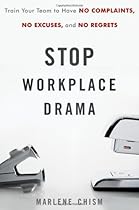
Stop Workplace Drama: Train Your Team to have No Complaints, No Excuses, and No Regrets By Marlene Chism

Stop Workplace Drama: Train Your Team to have No Complaints, No Excuses, and No Regrets

Stop Workplace Drama: Train Your Team to have No Complaints, No Excuses, and No Regrets
By Marlene Chism

List Price: $24.95
Price: $16.47 & eligible for FREE Super Saver Shipping on orders over $25. Details

Availability: Usually ships in 24 hours
Ships from and sold by Amazon.com

41 new or used available from $13.95

Average customer review:

Product Description

Overcome the interpersonal challenges holding your business back

Is your workplace riddled with gossip, power struggles, and confusion? Do you seek clarity in your management and cohesiveness in your team? Do you have a personal obstacle affecting your professional success?

If so, there is good news-help is on the way. Stop Workplace Drama offers down-to-earth, practical methods to help business owners, entrepreneurs, and private practice professionals maximize success, increase productivity, and improve teamwork and personal performance.

  • Identify "drama" barriers and help your employees break free to experience higher personal effectiveness and increased productivity
  • Each of the eight points is full of universal and practical principles any business leader, sales director or entrepreneur can put to use immediately
  • Author Marlene Chism has shared her signature process with organizations such as McDonalds and NASA
When you're in the thick of business competition, you and your team need to function freely without internal conflicts, confusions, or rivalries. Stop Workplace Drama ensures that your employees will be able to give their best to create a healthy, profitable workplace.

Product Details

  • Amazon Sales Rank: #29252 in Books
  • Published on: 2011-01-25
  • Original language: English
  • Number of items: 1
  • Binding: Hardcover
  • 229 pages

Editorial Reviews

From the Inside Flap
Stop putting fuel on the fire and take back control of your workplace

Gossip. Power struggles. Poor team coordination. These are all symptoms of workplace drama. They're the obstacles that can drain your company of its best talent, get in the way of true productivity and profit, and eat away at the effectiveness of your organization—that is, unless a leader steps up and takes responsibility for changing course.

Communications consultant and national speaker Marlene Chism has created an eight-step methodology that breaks through negative thinking that can contribute to drama in organizations of every kind and size. She has identified the gaps that drama creates—a gap between where your company is and where it aims to be and the psychological gap that occurs when people are faced with change and the fear that goes with it.

With Stop Workplace Drama, Chism shows how to change the way you and your organization confront and work through problems, implement effective management strategies in a drama-filled organization, and find new solutions that create positive growth for every member of your company. You'll learn how to:

  • Understand the different kinds of "drama roles" played in the office—and how to work through them

  • Create healthy boundaries, get your work needs met, and make the most of your valuable time

  • Seek viable opportunities and take responsibility for your efforts

  • Instill necessary changes without unleashing fear in your organization—which can lead to conflict

  • Cut through your personal drama so that it doesn't create further issues at work

In today's business world, where competition is fierce and economic challenges are more intense than ever, ending the drama has never been more essential. With fascinating case studies, illuminating insight, and workplace-tested strategies, Stop Workplace Drama will help boost the morale of your employees, maximize your company's potential, and put your organization on the road to success.

From the Back Cover
"Stop Workplace Drama does more than reveal excuses for the inclination to drama in the workplace; it offers a wealth of ideas to improve communication, trust, and leadership that will help eliminate the energy, time, and talent drain that drama creates."
Stephen M. R. Covey, coauthor of the New York Times and the Wall Street Journal bestseller The Speed of Trust

"This easy-to-read book is a must-have for anyone who leads others and wants to improve workplace dynamics so your people can enthusiastically say 'Thank God It's Monday!'"
Roxanne Emmerich, author of Thank God It's Monday!: How to Create a Workplace You and Your Customers Love

"Stop Workplace Drama offers practical ideas to improve communication in the workplace to eliminate power struggles, backstabbing, and office drama."
Michael Linenberger, author of Master Your Workday Now!

"Marlene Chism's no-drama approach is down-to-earth and effective, plus it's communicated with good humor and a very big heart."
Rick Hanson, PhD, coauthor of Buddha's Brain: The Practical Neuroscience of Happiness, Love, and Wisdom

"Stop Workplace Drama is filled with fresh strategies to help leaders navigate change, reach their objectives, and create a positive work climate—all at the same time!"
Jill Konrath, author of SNAP Selling and Selling to Big Companies

"Marlene Chism has given the Drama Zone its own zip code! This book is a brilliant approach to halting drama in the workplace—right here, right now—and at every level within the organization. No smoke and mirrors, just real-world tips, tools, and techniques to creating a 'no excuses, no complaints, no regrets' workplace. Count me in!"
Anne Bruce, speaker and bestselling author of more than 14 books, including How to Motivate Every Employee

"Any entrepreneur who wants to eliminate excuses and complaints and increase cooperation will benefit by reading Stop Workplace Drama."
Mike Michalowicz, author of the cult-classic The Toilet Paper Entrepreneur

About the Author
MARLENE CHISM
is a consultant, trainer, and professional speaker. She is the founder of the Stop Your Drama methodology—an eight-part process for helping managers and small business owners identify the barriers that are holding back their teams. Marlene is also the creator of Attitude Builders, a monthly teleseminar program developed for busy managers who want easy staff development with no prep, no plan, and no problem. Each month managers learn from experts, authors, and transformational leaders to help increase productivity and personal effectiveness. Working with high-level professionals who want to increase personal performance, Marlene has shared her processes and programs with companies like NASA and McDonald's. For speaking information, visit www.MarleneChism.com, and for free resources, visit www.StopWorkplaceDrama.com.

Customer Reviews

Shawn Driscoll5
Stop Workplace Drama isn't like any other business or management book I've read. And that's a good thing. It approaches common issues in the workplace with insight, humor and practical strategies to eliminate the drain and strain that Drama causes. I love the way Marlene Chism explains the roles people play in creating Drama and her strategies for getting off the drama triangle and creating real results. This book takes a fresh look at the challenges of working and leading and makes it possible to cut through the chaos drama causes with grace and clarity--no matter what title you hold.

A no-brainer method for ending drama!5
When I got an advanced copy of Marlene's book, my intent was to do a quick scan and write a short, courtesy review. But I found it impossible to scan. I found myself reading it! When I finished, I reread it and made notes in the margins. Using shorthand, I indicated the initials of employees of whom I had applied Marlene's principles with effectively as well as those that I failed to use Marlene's principles...and ended up feeding drama.

I've recommended Stop Workplace Drama to many others. Why? Have you ever hurt your leg or foot or toe, and instead of going to the doctor, you got used to limping? Maybe you told yourself that you were too busy to see a doctor. Perhaps you thought the problem would clear up on its own. But over time, you got used to walking funny. Pretty soon, you couldn't even remember what it felt like to feel normal or not walk around with discomfort.

That's what drama is like. When viewed from a distance, it might appear to be charming, quaint, or even funny. But when that drama gets closer or begins to touch you personally, it becomes painful and draining, hurting not only at the immediate source of drama, but able to harm and damage other formerly-healthy parts of the whole system.

Marlene's book is a powerful how-to. If you've forgotten what it's like to feel "normal" because all around you is drama, stop hoping it will fix itself. Get Marlene's book, read it, apply it. Find out why it's destined to appear on the desks of every leader who is serious about creating outstanding results with people.

Great insight5
Appreciate the insight on how the different personalities relate in the work environment. Important to understand how they all play off of each other and how to help avoid conflicts by nipping certain activities in the bud (so to speak). Also, great info on what to look for, or watch out for, when selecting those who will be working with you...

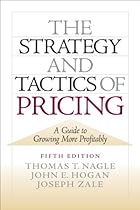
The Strategy And Tactics Of Pricing By Thomas Nagle, John Hogan, Joseph Zale

The Strategy and Tactics of Pricing (5th Edition)

The Strategy and Tactics of Pricing (5th Edition)
By Thomas Nagle, John Hogan, Joseph Zale

List Price: $91.50
Price: $57.65 & eligible for FREE Super Saver Shipping on orders over $25. Details

Availability: Usually ships in 24 hours
Ships from and sold by Amazon.com

41 new or used available from $53.83

Average customer review:

Product Description

KEY BENEFIT: The Strategy and Tactics of Pricing shows readers how to manage markets strategically—rather than simply calculate pricing based on product and profit—in order to improve their competitiveness and the profitability of their offers.

KEY TOPICS: Strategic Pricing; Value Creation; Price Structure; Price and Value Communication; Pricing Policy; Price Level; Pricing Over the Product Life Cycle; Pricing Strategy Implementation; Costs; Financial Analysis; Competition; Measurement of Price Sensitivity; Ethics and the Law
 
MARKET: For those interested in learning about market pricing.

Product Details

  • Amazon Sales Rank: #4368 in Books
  • Published on: 2010-03-12
  • Original language: English
  • Number of items: 1
  • Binding: Hardcover
  • 352 pages

Customer Reviews

Value Pricing & Customer Value Management Can Transform Business5
Disclosure - I worked with Tom Nagle, John Hogan and Joe Zale at Monitor Group and continue to work with them at LeveragePoint, where we are coding many of their ideas into software tools, so my review may be a bit biased.

This is a major update of the classic book on strategic pricing, a book that introduced many of us to the field and that taught us how to think about customer value and how it relates to price. In my case, this book also helped me to sharpen my understanding of pricing, segmentation and bundling and changed how I thought about sunk costs and pricing. If I had read this book ten years ago I would be a wealthier person today.

What's New in the Fifth Edition?

A completely new chapter on "Pricing Strategy Implementation" identifies the challenges involved in embedding strategic pricing principles within an organization and describes how managers can lead a structured change process to build a commercial organization more consistently focused on value creation, for the firm and its customers

The revised chapter on "Pricing Policy" provides a theoretically grounded framework to describe specific policies for managing price changes for a variety of situations including raw material cost increases, demand recessions, and new product launches.

The chapter on "Value Creation" for the first time addresses explicitly how to deal with value differently when it is driven by subjective psychological drivers (such as doing the right thing for the environment) rather than by tangible monetary drivers (for example, saves money on fuel).

The chapter on "Value and Price Communication" has been substantially revised to describe how to communicate value in a wide variety of product and customer contexts. It demonstrates how to target communications to affect specific behaviors throughout the customer's buying process.

The chapter on "Price Setting" has been expanded to provide a robust process for setting prices that can be widely applied both to consumer and business markets.

Throughout the book, we have updated examples with more topical illustrations of current pricing challenges (such as iPhone pricing, new models for pricing music, and services pricing).

This is a book for CEOs, VPs of Sales, Marketing and Finance4
As my due diligence for a panel on pricing next week (Oct 20) in Vancouver ([...]) I have been reading Nagles 5th edition of his textbook on the subject and am thoroughly enjoying this book. It is as much the application of psychology as analytics. He makes the best arguments and execution strategies for value pricing I have ever read.

In his thoroughness I am finding lots of sales aha moments. These are the times when you encountered types of buyer and competitor behaviour, made a decision, learned to regret it, lost $$$$$$ , and over time developed/learned better responses. Nagle describes the theory behind why the better responses worked and how to improve even more . This is a very similar experience I had when first reading Geoffrey Moore. "All the time spent learning through doing when someone had already written this down". Of course had I known much of this sooner I would have been even more of a pain in the ass to my superiors/employers.

There may not be one book that contains everything on pricing, but this one comes extremely close. His generous use of examples pulls tired brains like mine through some of the numeric analysis. I know I will be a much better salesperson from reading this book. I suggest this is a book for CEOs, VPs Sales, Marketing and Finance in any type of company. Thanks Steven Forth for dropping this copy off to me.

Very Good!5
Highly recommended. I read three books on pricing and tis was by far the most in-depth and clinical in its approach.

Four Missing Steps To Pricing Like A Pro

"Nowadays people know the price of everything and the value of nothing."
    - Oscar Wilde

Too often startups take a dangerous route to setting price: just looking at how much it costs to make and how much competitors are charging, and then setting the price in between.  The ambitious may even include "willingness to pay" to justify the numbers (but we now know better than that).  But there is a better way.  While costs and the competitive alternatives are certainly relevant inputs to pricing decisions, these companies are missing a critical component of pricing that causes them to leak profits.  Top-notch pricing organizations know that understanding and quantifying customer value needs to be at the heart of these decisions.  

If you're like most, this is where you say "But my business is different!  These economic calculations just don't work for us."  But I disagree.  Is it hard?  Sure it is.  If it weren't, we'd all be much better at understanding how to win with pricing.  The reality is, if you are having trouble understanding and estimating your economic value, more than likely you are facing the bigger problem of not truly understanding how your product positively impacts your customer financially.  And that is a big problem that needs to be addressed, especially in B2B markets.

Ready to get started?  Follow these four steps to quantifying customer value and you'll be on the path to pricing like the pros.

Step One:  Identify the Alternative
Better pricing is achieved by understanding how much more or less economic value you drive relative to the other options that are available.  Accordingly, the first step to understanding your value is to identify, from the customer's point of view, the competition (also known as the NBCA – Next Best Competitive Alternative).   Let's say we are in the software business, and one potential customer is currently using IBM's solution which costs $250 per month, while another customer is doing "nothing" (or managing in house, depending on how you look at it).  In the first case, we'll need to look for ways we provide differentiated value above and beyond IBM's $250 solution in order to capture a premium.  In the second example, our story needs to illustrate how we are better than doing nothing and illustrate the value we provide above current practices in order to get customers to sign up.

There are three important implications here.  First, the competition is your friend!  We will build upon the NBCA's offer (over-priced or under-priced, it is a real option for customers to purchase) and identify ways we deliver more value.  It is much easier to find small additional value above the IBM offer than it is to find a ton of value from the ground up, as is the case when the NBCA is "do nothing".  This is a major challenge for startups in a new space.  Try to overcome it by looking for realistic but favorable NBCAs for your product.  For example, instead of "do nothing", are they really managing internally?  What does that cost them in salary?

Second, as we see in this example, different customers have different NBCAs, so your value story will change from customer to customer.  You may be 5% better than IBM but 50% better than in-house, which leads to different levels of differentiated value.

And third, these NBCAs have different price tags.  Since we are looking for incremental value above our competition, this leads to different levels of total value added, and different absolute prices.  In other words, we are $150 better than "do nothing" vs. $50 better than IBM – total value of $150 ($0 + $150) vs. $300 ($250 + $50).

Identifying your competition may seem like a no-brainer, but it has big implications for segmentation, offer design, customer targeting, and sales proposition (all topics for another day). So put some thought into this and pick an NBCA that is relevant to a current sale and will be useful down the road.

Step Two:  Quantify Your Superiority
This is where it gets fun.  We are ready to really dig into how your product is better than what is happening today (the NBCA).  Back to the software example – our product helps our customers' systems work 5% faster than if they use the IBM solution.  But what does faster mean?  Why do companies want faster?  In 2008 at eBay, faster systems meant more revenue per listing.  The site was loading too slowly and eBay was losing out on buyer bids in the final seconds of an auction.  A faster system captured more last second bids in time, creating higher sell prices, happier sellers, and a higher fee for eBay.  In a call center, faster systems might lower call time and reduce telecomm and labor costs.  The same feature can drive different amounts, and different types, of value for different customers.

Let's dig into the eBay example.  How do we put a number to this value?  The simpler the math, the better.  You will want to show your customers how you came up with the number, so it's best to avoid partial differential equations and other forms of analytical confusion.  Start with some reasonably conservative assumptions and basic customer knowledge.  Let's say a system that is 5% faster than the IBM offer means there is 1% better chance an additional bid is placed on any given auction item (compared to the performance with IBM's solution), and the average bid increment is $1.00.  eBay gets a 5% commission on sales, and handles 10 million auctions per month.  These assumptions let us roughly quantify the performance above and beyond IBM, the NBCA.  There is always more than one way to quantify this value, so consider how your customer will think about it, what data you have, and what data you can easily get.

Feature:  System runs 5% faster than IBM 
Probability of additional bid: 1%   (source: performance tests, assumption)
Average incremental bid: $1.00   (source: customer research)
eBay commission (%): 5%   (source: customer website)
eBay auctions per month: 10,000,000   (source: customer research)
Value delivered: $5,000 per month   (source: calculated)

Based on this math, we believe we add $5,000 / month of positive differential value (what is above and beyond what IBM offers for $250 / month).  This demonstrates that we are impacting such a massively important value driver to eBay that even a slight performance advantage over IBM allows us to justify a significant price premium.

At this point, don't worry too much about perfecting the numbers, just be conservative.  Roughly right is better than precisely wrong.  As you move forward, customer conversations, annual reports, pilot programs, and field tests will help refine the inputs.  The important thing is to understand how we are driving value, and roughly how much it is worth.

Step Three:  Acknowledge Your Deficiencies
Your story must be fair and believable to gain any traction with the customer, and a key step is to acknowledge that the NBCA does have some economic advantages.   If a customer thinks we didn't look at the entire picture, they may think we're cooking the books in our favor and not providing a real view of the world.

I have never seen a situation where there is no negative differential value, so be careful skipping this step.  If the NBCA has superior performance on a different feature, you can replicate math like we used above.  Another very common negative differentiator is the switching cost from the current solution, often in the form of installation time or employee training.  Let's look at how we may quantify the installation cost in our example:

Feature: Installation & Training Cost (Negative)     
IT Man hours to install and train: 120   (source: assumption)
Fully loaded IT staff cost per hour: $50   (source: market research)    
Amortization period (months): 36   (source: assumption)
Negative Differential Value: $166 per month   (source: calculated)

Just like in our calculations on positive differential value, we want to use numbers that make a conservative case.  The value here is very small compared to the positives, so use numbers your customer will believe and quickly make the case is not a big issue.

Step Four:  Put it Together and Capture Your Value
In most cases, you'll have multiple positive and negative drivers to consider, but for now we're keeping it simple.  We have our NBCA identified as the $250/month IBM solution.  We have determined that we provide an additional $5,000/month in positive value, but have a negative differentiation of $166/month.  So now what?

Our net differentiated value (positive value minus negative value, in this case $5,000 - $166) is $4,834/month.  Since we are more valuable than the IBM offer, their price of $250/month becomes a hard floor for our pricing.  Anything below this number can be very dangerous (more on this in our next article on price wars).  Our ceiling is that differentiation plus the price of the NBCA, or $5,084 ($5,000 -$166 + $250).  Above this price you are asking your customer to make an economically irrational decision.

So here we have created our pricing band – from $250 to $5,084 per month.  Decisions on how to share that value creation band with your customers (e.g. where to set your price) depend on your company's strategy, the industry dynamics, and degree of innovation.  In mature and highly competitive markets where innovation happens on the fringes, I typically see companies capture 10% of that differential value.  In this case, that would mean 10% of $4,834 (net differentiation) on top of the NBCA price, or roughly $733/month ($250 + $483).  More aggressive companies who focus on profit or operate in younger markets often captured roughly 30% of the net differential value.  In some cases, such as highly innovative products where psychological drivers are in play or unquantifiable pain points exist, nearly 100% of that value can be captured.

With this analysis in hand, your company can make informed commercial strategy decisions.  Value-based pricing is not just about coming up with a price.  It will help expose the core value of your business and provide a deeper understanding of how you are impacting your customer base, and how that impact varies from customer to customer.  It will change the way you think about your competition, marketing and sales, and product development.   And at a minimum, you can maybe prove Oscar Wilde wrong and understand the value of at least one thing – your own product.

About the Auther:- Prior to beginning his MBA at MIT Sloan, Jim spent five years as a consultant at Monitor Group. There he focused on pricing, marketing and sales strategy, helping his clients grow profitably. Jim has worked in multiple countries and over a dozen industries with companies ranging from startups to $100Bn in annual revenue. He has extensive experience in value-based pricing and sales, developing and executing commercial strategies, and training clients on pricing best practices. Jim holds a BA from Northwestern University, where he graduated cum laude with degrees in mathematics and philosophy.

Thanks to MIT Entrepreneurship Review

4 Tips For Handling Overwork And Overwhelm

Today's guest blogger is Marlene Chism, author of Stop Workplace Drama: Train Your Team to have No Complaints, No Excuses, and No Regrets(go buy a copy by clicking the link - there's some great advice in there!). You can read more about her at the end of the post. Here's Marlene...

Are you overwhelmed with a heavy workload only to get another unrealistic request from your boss? Is it really the workload, or could it be a communication problem?

Often the real challenge is developing the courage to tell ourselves and others the truth about what we can do. What we do to avoid a conflict, or dealing with someone's disappointment is to offer something for which we are unprepared to deliver due to time constraints, abilities, or knowledge. Instead of making a promise you can't keep, or keeping the promise but dropping another ball, what if you could just tell the truth, and still get the job done?

In my book, Stop Workplace Dramathe third principle is "tell yourself the truth." Instead, much of the time we make agreements we can't possibly keep, or we refuse to ask for what we want because, "I already know what he will say." Or we simply play the victim and complain about how unfair life is, or we regretfully drop the ball because our stamina gives out before our will, then we give an excuse about why we dropped the ball.

This leads to ineffective communication between boss and employee and spreads negativity and drama. These four tips will help you to manage a heavy workload while improving workplace relationships:

1. Tell yourself the truth
2. Identify your choices
2. Tell your boss the truth
4. Communicate responsibly

Tell yourself the truth
First you must step out of denial by pretending that you can get everything done. To deny the facts means you are either going to disappoint someone or make yourself physically ill. If you really cannot do all that is asked, you must first face the facts of the situation. Facts include project deadlines, current priorities, estimated length of time to get a project or task completed, resources available.

Identify your choices
Now that you have been honest with yourself, you can list your choices. Can you delegate some of the tasks? What if you could think outside the box and find an assistant who would charge a small amount to do some data entry? What about hiring a personal assistant to free up some of your other obligations? There may be options you have not yet considered, but beware that any choice you make sets the stage for the same level of expectation and that is why you must be honest with your boss.

Tell your boss the truth
The boss really has no idea that you are swamped. She just wants to take things off of her plate. You have to let your boss know the facts. Don't whine or complain and don't promise that you can deliver something you can't. The way to approach your boss is to state the facts, and the priorities, then ask your boss to lengthen a deadline on another project, or ask a team member for assistance. The fact is, you can't add more than 10 percent more of a workload on anyone without offering additional resources. If you are being asked to double up, something has to go, and you must be responsible for helping the boss to understand the facts, the priorities and the consequences.

Communicate Responsibly
Learn how to engage other team members or co-workers through effective communication. Again, no complaints or excuses, simply go straight to the solution. Ask for what you want. Instead of saying, "This is not fair…." And "Look what I'm expected to do…" Instead say, "I've been given another task that is going to take three hours. Would you be willing to…" then make your request. Offer to help out in return, then give the person credit for helping you. You will help yourself, you will show you are problem solver to your boss, and you will also improve teamwork and morale.

- Marlene Chism is a speaker, author and founder of The Stop Your Drama Methodology, an eight-part empowerment process to increase clarity and improve productivity and personal effectiveness. She is a dynamic business and motivational speaker who has the unique ability to speak across the boundaries of many types of audiences: from the fortune 500 executives, to HR professionals to front line employees. Marlene has a master's degree in HR Development from Webster University and is the author of Stop Workplace Drama: Train Your Team to have No Complaints, No Excuses, and No Regrets.Learn more at www.stopworkplacedrama.com

Thanks to thoughtLEADERS, LLC / Mike Figliuolo / http://thoughtleadersllc.blogspot.com/2011/03/4-tips-for-handling-overwork-and.html?utm_source=feedburner&utm_medium=email&utm_campaign=Feed%3A+ThoughtleadersLlcBlog+%28thoughtLEADERS+Blog%29

7 Agenda Items For Your Writing Group’s First Meeting

This is the third post on our series about writing groups. You can read the first one here and the second one here.

Now, you've done it. You've launched a writing group, or you're about to. What now? It's time to organize. Here's what to do at the first meeting:

1. Break the Ice

Give each member a few minutes to introduce themselves, or try the team-building game Two Truths and a Lie: Have members come prepared to present, with a straight face, three interesting things about them; everyone else votes on which two items are true and which is false (though it can be a variation on the truth or an aspiration).

2. Set a Schedule

How often will the group meet? Every week is probably pushing it, so vote on whether sessions will be held every two weeks or monthly. Agree on meeting duration. (Two hours is a good block of time.) Ask members to commit to attending regularly and arriving punctually.

3. Establish Goals

What do you and the other members want to get out of the group? Is everyone determined to get published, or is the experience just a way to solicit feedback in a supportive environment and work on writing skills? Make sure everyone has a common ambition. Consider creating a mission statement.

4. Determine Protocol

Briefly discuss meeting structure: Does everyone read every time, or do members alternate every two or three meetings? Do members email work in progress in advance so that others can prepare critiques, or do they give cold readings? Will your group alternate between both strategies?

Consider having members take turns preparing mini-tutorials based on their experiences or research, like describing the different archetypal characters or sharing a list of plot pitfalls. Or give each person a chance to share an advice tidbit from an accomplished author.

5. Take a Break

Allow five or ten minutes halfway through the session for a snack and small talk, but don't let it drag out.

6. Read Samples

Give everyone a chance to read briefly from a work in progress. Have members start right off without a preface and then take a moment to talk about the story. Save critiques for subsequent sessions — this is just a chance for everyone to get a taste of others' writing styles.

7. Plan Ahead

Agree on what to do next time: Have everyone email an excerpt to the group a week before the next session, prepare a short selection to read aloud, or plan to bring hard copies of a sample passage to hand out. (Materials for cold readings by writers or others should be no more than a couple of pages; excerpts sent in advance can be longer).

Decide what the focus will be each time: crafting an opening scene, establishing character, etc. Focus on technical aspects for a while before delving into content.

Thanks to DailyWritingTips

From FarmVille To Bangladesh: Mobile Apps Try To Fulfill Their Potential

From FarmVille to Bangladesh: Mobile Apps Try to Fulfill Their PotentialIn a remote corner of northern Bangladesh, a newborn girl contracted malaria and pneumonia, two big killers of children in the developing world. With the nearest hospital six hours from their island by boat, the child's parents prayed for healing and hoped for a miracle. It came in the guise of a community health worker, who used a special cell phone to collect and transmit the baby's health data to a doctor. She also administered antibiotics on the spot. As a result of a mobile phone application developed by Lexington, Mass.-based Click Diagnostics, help was dispatched and a life was spared.

"Mobile phones can be the way that almost half of the world will access health care for the first time," said Rubayat Khan, founding country director for Click Bangladesh who spoke as a member of a keynote panel on mobile health and banking at the recent BizTech@Wharton Conference. "Two billion people, or almost a third of the world's population, have never seen a doctor in their lives. Almost four billion do not have affordable access to health care."

Mobile technology is upending the traditional business delivery models in health care and a host of other industries. The increasing sophistication of cell phones gives companies an opportunity to tap into the device's mobility to reach people for a host of applications. Banking is another big user of mobile technology as more people use phones to pay bills, access account information and transfer money. "Everyone is going to start tapping [on a smartphone touch screen] to pay," predicted panelist Iqram Magdon-Ismail, co-founder of Venmo. His company offers mobile payment services with social features, such as letting people use their phones to pay back loans from friends.

While mobile technology has been around for years, special circumstances are coming together now to make it particularly viable. "The devices themselves have become much more capable," said panelist Vishy Gopalakrishnan, director of industry solutions at AT&T Mobility. "If you go back to the Palm Pilot [in the late 1990s], it was great at that time, but it was not necessarily compelling in terms of user experience." Developing applications has become easier, and prices for devices have come down. People also have become more comfortable using their phones for many applications, Gopalakrishnan noted. "When the dot-com boom happened, remember all the apprehension people had with putting out their credit card information on the web? Nobody thinks about that anymore. I use my mobile device for all kinds of transactions."

Panelist Omar Green, director of strategic mobile initiatives at Intuit Inc., credited two companies for changing the way people view mobile applications: Apple and Facebook. With the introduction of the iPhone, Apple turned the cell phone into a more user-friendly, multi-purpose device, while Facebook made people comfortable with sharing personal information online. Consumers rushed to buy smartphones and tapped social network apps for activities such as finding restaurants rated highly by other diners, leveraging the power of the American consumer to drive changes worldwide in the process. "When people in America start caring about something, and start spending their money on something, things change," Green said.

Mobile technology also has the power to make costly systems more efficient, panelists noted. Consider how Welldoc, a Baltimore company that uses cell phones and the web to manage the health of diabetic patients, is changing chronic disease management. Welldoc uses a mobile phone to give patients real-time coaching about their ailments, offering advice on matters such as how to bring down a glucose level that is too high, or raise it when it is too low. A summary of patients' habits and health data is sent to their doctors and caregivers. The program was so successful in improving patient health -- with broader implications of reducing the nation's burgeoning health care spending -- that Welldoc recently was asked to meet with the Food and Drug Administration and the Federal Communications Commission, said panelist Anand Iyer, Welldoc's president and chief operating officer.

Privacy, Compatibility and Monetization

But while the promise of mobile technology seems boundless, its execution can be more problematic. For one, there is the issue of protecting consumer privacy, which has become especially critical in the face of the Federal Trade Commission's "Do Not Track" proposal that would allow Internet users to block websites from collecting information about them. Companies that rely on ad-supported mobile apps, or websites designed for the phone, need to track consumers in order to target ads to them. That is how the firms make money. Without targeted ads, growth of mobile apps would dry up, panelists stated, because the cost would then be transferred to customers who are used to downloading the programs for free. "I would argue that 60% of the innovations coming out of [medical] startups would go to zero if there weren't ways of monetizing through targeting," Green stated.

The challenge for companies is finding the fine line between providing helpful information and preserving privacy. For instance, if a patient searches for articles on depression, would it be appropriate to target him or her with ads about depression medication? Gopalakrishnan argued that it can be done tastefully. Facebook has shown that people are comfortable with revealing things about their personal lives to a certain extent, he pointed out. The trick is for the company to use that information in a helpful and subtle way and to "give some assurance -- formal or informal -- that you're not going to share [personal data] with the whole wide world."

Another challenge is the issue of compatibility. Mobile app developers have to write different versions of their programs for different platforms, such as the iPhone, Android and the BlackBerry. Consequently, the programs take longer to implement and are more cumbersome to update, according to speakers at another BizTech panel, which focused on mobile applications. "If you want to win at mobile, you can't just pick one. You can't just say, 'I need an iPhone app,'" according to panelist Eric Blumberg, founder of Smarter Agent, a Camden, N.J., mobile technology development company for real estate agents. "You have to do all of them."

Making money from mobile technology also requires creativity, panelists said. Zagat, a well-known provider of restaurant reviews, charges a subscription fee to users, noted panelist Ryan Charles, who leads the company's mobile efforts. But when Zagat tried to put ads into its mobile app, paying users protested. "People said, 'Why do you have advertising on this app when you're charging me for it?'" he said. "People don't want double-dipping. There's a lot of resistance to that from users." Now, Zagat tries to find ways to boost its revenue by offering deals and other promotions.

Blumberg said Smarter Agent charges real estate agents and institutions, but is free to consumers. The app, which can be customized by individual real estate brokers, provides consumers with real estate listings. Along with a subscription fee, Smarter Agent also makes money through ads. The ads are not intrusive to people who find them helpful, Blumberg suggested. For example, if a home buyer is searching for a house with hardwood floors but comes across a property that does not have them, the app can serve up an ad from Ikea offering a deal on hardwood flooring. Such a targeted ad is much more effective than blanket TV commercials, Blumberg added.

The key, panelists noted, is to make ads part of the mobile user's experience instead of a disruption. "Advertising on TV is not advertising on the web. Advertising on the web is not advertising on mobile. [Placing ad] banners on mobile [is] probably going to drive most people away because your screen is only so big and you're putting a banner on it," Blumberg pointed out. So he tries to find a way to insert an ad where people will not mind as much. For instance, his company puts an ad on the blank screen that comes up when the phone is loading information. That ad replaces the spinner on the screen as data is downloaded. "Figure out how to put [ads into apps] so they're not [intrusive]," he advised, "so they're part of the user experience."

Some companies offer free apps, but charge customers for access to internal features, Charles said. For example, FarmVille is a game that lets users manage a virtual farm by planting and harvesting virtual crops, and raising virtual livestock. Players earn virtual money to pay for plants and animals as they gain experience, rise in game levels or by paying actual money. Another app, Smurf Village, is free to download but there is a charge for additional in-app content. For example, adding a wagon of "Smurfberries" can cost as much as $100. Charles called it a "free model with an in-app purchase." This strategy of monetizing mobile apps will not work with everything because consumers "might not be addicted to a certain section of The New York Times as much as they are to upgrading their Smurf Village."

The bottom line is that companies have to find methods of making money from mobile, and they are experimenting with ways to do it creatively. Without monetization, all the innovation will be wasted because the app will not be sustainable. The trick is to make the ad fill a customer's needs. "If ads really help you do things ... then they're not really ads, they're things that help you," Blumberg said. "If I'm moving and Home Depot is giving me 20% off my next purchase, is that an ad or is that a benefit for using the app? Advertising isn't a dirty word, but how you implement it can be."

Thanks to Knowledge@Wharton

Is Business-Centric Social Networking A Revolution --- Or A Ruse?

Is Business-centric Social Networking a Revolution -- or a Ruse?Programs like Twitter, Facebook and LinkedIn have become a popular way for families and groups of friends (or groups of strangers) to share information and organize their lives. Now corporations are hoping they can tap into those capabilities as a way to improve employee productivity, collaboration and communication on the job -- and a long line of software vendors, such as Cisco, SAP, Oracle, Microsoft, IBM and Salesforce.com, along with upstarts like Yammer, are hoping to position themselves as the platform to integrate social networking and business processes.

But will it work? And is it worth it? Research firm IDC projects that the global market for social platforms will jump from $630 million in 2011 to $1.86 billion by 2014. But while proponents tout the push for a more "social" business sector as a new era that will alter the way companies manage employees, skeptics say it could amount to nothing more than a ploy to help software companies sell more products.

"Clearly, social media has revolutionized how human beings interact," says Kendall Whitehouse, director of new media at Wharton. "It's logical to ask how it can transform internal business processes." Shawndra Hill, a Wharton operations and information management professor, agrees, but says there is a lack of concrete measurement on the impact of social networking on business returns. "Social networking in the enterprise sector is relatively new, and better tools can enable people to communicate across an organization. But before this really takes off, there needs to be some proof that these things are useful."

Today, creating effective social networking applications for the enterprise space is still a work in progress. Salesforce.com in February launched a social business tool called Chatter.com that is an extension of the company's cloud-based customer relationship management software. In many respects, Chatter.com -- which was promoted by Salesforce with ads that aired during the Super Bowl -- mimics Facebook and Twitter in allowing employees to share profiles, comment on projects and "follow" colleagues as well as corporate business processes such as invoices and sales proposals. In December, Salesforce.com CEO Marc Benioff, the most visible champion of social business, described Chatter as being like "your business is Tweeting you."

Wharton management professor Nancy Rothbard says the introduction of social networking into office culture could have "profound" implications for the way businesses are structured. "The benefit of social networking is that it creates communities, but it creates a very different kind of community than offline communities," notes Rothbard, who is currently studying how people juggle their personal and professional personas online. "The piece of this that can be really amazing is that it creates community action, awareness and knowledge about issues and events that may be relevant, and creates a sense of intimacy, which can lead to trust and closeness."

It is unclear, however, if that idealized scenario can be fully achieved in a real-life workplace, Rothbard says. Social networking in the broader public sphere has allowed people to become virtual "friends" of politicians, actors and famous musicians, and has created the feeling that users can interact with those public figures on a familiar level. But what happens if the same issues of hierarchy come into play when a CEO "friends" all of his or her employees on a work-based social network, Rothbard asks.

Tearing Down Silos

Many of these social networking and management experiments are being undertaken by traditional business-focused technology companies. At its Lotusphere conference in January, for example, IBM executives talked about how the company was working to integrate social tools into its own operations with the addition of collaboration software for viewing documents, forums to post ideas and mobile applications. IBM has also been building social tools into its cloud-based LotusLive business networking and collaboration suite for use in a range of sectors including marketing, customer service, sales, product development and human resources.

In October, Cisco CEO John Chambers said the company has been using social networking internally to "flatten the organization." In this model, social networks are used to build product and project management teams. Expertise is quickly rounded up, and employees are judged on their collaboration skills. Murali Sitaram, general manager of Cisco's enterprise collaboration platform, wrote in an October blog post that companies will have to transform as "large numbers of Gen X and Y individuals start entering the workforce."

Because young people increasingly rely on Facebook and Twitter to communicate in their personal lives, employers must bring similar tools to those workers, experts say. Cisco turned its internal social networking software into a product called Quad, which integrates with business and Internet content management systems and includes Facebook-style status updates, instant messaging and a task manager. However, there are risks. Chambers said in October that Cisco's move to use a social networking hierarchy to run the business was among the most significant challenges facing the company. "The thing that's about to change for organization structures is that executives will serve on social networking groups ... based on function," noted Chambers. In this model, executives are viewed more as general managers and can be called on to fill multiple functions based on their expertise.

Benioff frequently cites Dell, a key partner of Salesforce.com, as an example of how social networking -- specifically Chatter -- is changing corporate interaction. Dell has rolled out Chatter to 113,000 employees. Company officials said they found the application was effective in connecting its sales team to the manufacturing department, which helped the firm better meet delivery promises to customers and in setting expectations overall. Salesforce.com also uses Chatter internally.

"These networks provide this vast democratization and it blows up ... the hierarchy in your company.... It empowers and enables the employees who are really making a difference, which are not necessarily the people, for example, who are working for me," Benioff told the audience at GigaOM's "Net:Work: The Future of Work" conference in December. "It's not my direct reports or even my top managers.... I started to see [that] the people adding value in the company were not the senior VPs and the VPs, but this powerful network of individual contributors [providing business ideas]."

Meanwhile, Salesforce.com has made a series of acquisitions to bolster Chatter's features. In recent months, Salesforce has acquired Manymoon, a social productivity company; DimDim, which provides web meeting tools; and Activa Live, a corporate chat software specialist.

According to Whitehouse, these types of products can serve to break down the dreaded siloed organization by weakening barriers between departments and creating a venue for employees to trade insights and offer feedback. When companies grow, information and knowledge is more difficult to surface because "people are too busy and are focused on their own outcomes. The revolutionary platforms like Facebook and Twitter began as consumer products focused on individuals," he says. "That kind of information interchange would be hugely valuable for businesses. How can we bring some of the energy and information exchange found in the personal sphere to the enterprise?"

Although the goal of many of these networking programs is to break down silos, there are also drawbacks to total transparency in an office setting, according to Rothbard. For one thing, employees could easily become overwhelmed by too much communication. For another, there are significant variances in the way people post on social networking sites -- or whether they post at all.

"With Facebook, the implications are very different. If I have a very bare-bones page ... who really cares?" Rothbard notes. In an office setting, where posts and updates are being used to evaluate work performance, however, it "could have negative repercussions. You could also have people who post too much. There are 'TMI' [too much information] people in terms of personal stuff. There could also be 'TMI' people in terms of work -- to the point where you just say, 'Stop already'.... There are issues generally about information processing, but also of hierarchy and status that play out in terms of what people post, who they are connected to and how comfortable they may feel revealing information."

The value of corporate social networking may not be immediately apparent, Hill notes, but companies need to consider the end results they hope to achieve. "What are the needs of the organization?" asks Hill. "Some will use social networking to get better insights on what improved communication means to the business. Others will use the transparency to observe how companies and employees interact and then link that communication to business performance."

In Need of a Hype Check?

Andrea Matwyshyn, a Wharton professor of legal studies and business ethics, warns that the concept of social business tools can be oversold. "There are uses for social networking as a collaboration tool when working together in teams," she says. "However, merely having social networking on all the time can divert employee attention."

In other words, social tools need to be balanced with other priorities, and they may not be as transformative to office culture as expected. "Conceptually, there should be a lot of value added," Matwyshyn notes. "But the benefits will be different for each worker."

Hill agrees. If employees use corporate tools for microblogging, blogging and creating profiles for purposes other than what was intended, the applications may become just another excuse to procrastinate from the task at hand. After all, many workers likely spend at least some part of the day sneaking peeks at, and updating, their profiles on Facebook and Twitter.

A lack of widespread employee usage of corporate social networking tools would be equally problematic, Hill points out. After all, collaboration software and knowledge management systems have been around for years, with varying levels of success. "It's not clear that corporate social networking will be any different than what was offered before," Hill notes. "The employee asks, 'Why would I trust your team with my information?' The tools are better, but information is still in a silo."

According to Kartik Hosanagar, a Wharton professor of operations and information management, social business tools will likely find users, but the positives of these efforts may be vastly overrated. "I'm a little skeptical about usage, but I'm even more skeptical about benefits to corporations," Hosanagar says. "Companies may use it, but I don't think it will provide the productivity benefits vendors claim they will provide. To me, it feels like a reasonable feature of collaboration software, like Microsoft's SharePoint, rather than revolutionary new software for enterprises. In other words, Chatter is not exactly the big thing that Salesforce.com's original [customer relationship management software] was."

The buzz around social networking may just be the latest iteration of technology's hype cycle, Hosanagar suggests. "There is too much buzz about social networking and about the 'consumerization of the enterprise space'.... Vendors are capitalizing on it by offering the next 'put-the-buzz-word-in-here' products, and firms are falling for the trap."

The Wild Card

Rather than companies buying an entirely new program, the current generation of enterprise software may evolve to the point where social networking features are standard, Whitehouse predicts, because businesses continue to desire the identity management, security and enterprise-level support of their existing systems. "Today, social networking is being thought of as a separate thing," Whitehouse says. "We'll see that fade over time, and it will become just part of the way we interact."

Hill agrees, noting that gaining scale is key to making social networking successful. If only a few employees use social networking, the benefits dwindle. Chatter has a good chance at staying power because it is built on top of the Salesforce.com's existing platform, she notes. "To succeed in a big way, social networking will have to interface with standard enterprise software."

Thus, the technology suppliers that are currently ingrained with existing business processes may have the best shot at social networking success with corporate customers, Whitehouse says.

The wild cards in this market, however, are current social networking champions like Facebook. While Salesforce.com is aiming to be the Facebook of the enterprise sector, it is possible that Facebook, Twitter or LinkedIn could launch a business version. The chances of that are remote, Matwyshyn says, but such a move would be interesting. "To work in business, Facebook features would have to be improved with enhanced security," she notes. "But the ease of use would already be there."

Thanks to Knowledge@Wharton

Can Skype Go Corporate?

Can Skype Go Corporate?Right now, Skype is a go-to service for far-flung families and friends trying to stay in touch. It offers free or low-priced calls and the chance to converse face-to-face via a webcam. But the company, which is widely expected to launch an initial public offering in 2011, wants to move beyond helping travelers to stay in touch on the road or allowing a grandmother to "be there" for a grandchild's birthday despite living thousands of miles away.

Skype also wants to become a place where deals are made by CEOs and rank-and-file employees alike. Once seen as a renegade company that would give entrenched telecommunications providers a run for their money, Skype is now hoping to prevail in the business arena. Founded in 2003 by the developers of peer-to-peer file sharing software Kazaa, Skype was purchased by eBay in 2005. Three years later, the online auction giant sold a majority stake in Skype to an investor group.

The move into the corporate communications sphere will take Skype into closer competition with companies such as Cisco Systems and other established business technology players. Indeed, since regaining its status as an independent company, Skype has continued to add new features and embed its service into devices such as televisions and smartphones. Last October, Tony Bates, who was most recently general manager of Cisco's enterprise, commercial and small business unit, was tapped to become Skype's CEO.

Skype's efforts to become more business-focused hope to capitalize on the increasing influence that consumer tastes and preferences have in dictating what types of technology will be used by corporations, according to Andrea Matwyshyn, a legal studies and business ethics professor at Wharton. Consumers are using their personal iPhones at work and want the software they use at the office to resemble websites they frequent during leisure time, such as Google or Facebook. And they want to communicate at work with tools like Skype, just as they do at home.

"Skype has built a loyal user base for several years. For most consumers, Skype is associated with communication," says Matwyshyn. "As a result, businesses will give Skype a chance." Peter Fader, a Wharton marketing professor agrees. "Skype is an essential [tool] and has so much potential," Fader notes. "The Skype name is already a verb [as in 'skyping' with someone] and can certainly go down the business-to-business path. That's where the money is."

Show Me the Money

Gravitating toward a sector with significant profit potential makes sense for Skype because, "unless you're going to be a site that attracts advertising, you have to find other ways to make money," says Wharton operations and information management professor Saikat Chaudhuri. "The key for Skype is to offer enough value so the business user will buy a premium version of Skype."

Skype currently offers two tiers of service: Free services include instant messaging, audio-only calls and video chats between Skype users. Skype charges users who make or receive calls from landlines and mobile phones. There is also a fee to get voicemail and send text messages. Plans range from 9 cents a minute for calls to $5.99 a month for group video calling services.

This "freemium" business model is designed to attract users through the lure of a freebie and then convince them to pay for more advanced capabilities. As of June 30, 2010, Skype had 560 million registered users and 8.1 million paying customers. For the six months ended June 30, Skype reported earnings of $13.1 million on revenue of $406.2 million. "The freemium model hasn't been a runaway blockbuster, but Skype is doing a nice job with it," Chaudhuri notes.

Wharton management professor David Hsu has a slightly different view. Sure, Skype has a massive user base, but the percentage of paying customers could be much higher. "Consumers are getting a very good deal," Hsu states. "The initial revenue model was to charge for minutes, but that's not generating enough profit. They have to be bold and devise a real pricing scheme for all users. It doesn't have to be that expensive."

According to Hsu, Skype's plan to target corporations is a good start toward developing a more profitable business model, but ultimately he thinks Skype should pursue an advertising model for free services, consider charging more casual users, or vary network quality based on premium versus free service. "The 'economy' passengers on Skype shouldn't get the same quality as first class," Hsu says. "I see very little alternative but to move away from mostly free service. You can't subsidize everybody indefinitely."

Breaking with Tradition

Skype laid out a strategy to expand its business offerings and target premium services to the sector in an August 2010 filing with the U.S. Securities and Exchange Commission that declared the company's intent to do an IPO. The IPO was expected to come in the first half of 2011, but in January, The Wall Street Journal reported that the IPO had been pushed back to the second half of the year to give the company more time to increase its value.

In the August regulatory filing, the company noted that a survey of 40,000 Skype users revealed that 37% "use our product platform occasionally or often for business-related purposes." That statistic underscores what the company described in the filing as "a significant opportunity to better serve the communications needs of the small and medium enterprise segment, as well as larger enterprise customers."

Since its initial filing with the SEC, Skype has made a series of moves to bolster its position with business customers:

  • At the Consumer Electronics Show last month, Skype launched group video calling services for consumers and businesses. Video calling accounted for 40% of all Skype-to-Skype usage in the first half of 2010. Skype-to-Skype means that callers on both sides of the conversation were using the service.
  • Skype launched video calling for the iPhone and acquired Qik, a company that provides mobile video software.
  • Skype partnered with Avaya, a company that provides video and voice communication equipment to large companies. Avaya will integrate Skype's technology into its systems.
  • Skype launched a program to certify systems integrators, or firms that would install Skype at businesses.
  • The company also launched a software program called Connect that allows businesses to integrate Skype into traditional phone networks. Employees can make calls via Skype through their landline phones at Skype's calling rates, while customers are able to call in from their computers by clicking a Skype icon on a business's website.

However, Skype's plans to be a business player may not go so smoothly. Kendall Whitehouse, director of new media at Wharton, says that businesses may be more comfortable with larger rival Cisco for enterprise-wide deployments. While business executives may know Skype from personal use, "Cisco may have more brand awareness on the business side. Skype came up through the free consumer space, not unlike Facebook," notes Whitehouse. "There's a lot of habit and tradition in the workplace. Why do you use Facebook to connect with friends and still use e-mail for business correspondence?"

Skype's efforts to build a bridge to corporate America are not uncommon -- witness Apple's business push for the iPhone and iPad. However, making the jump from a consumer product to a business tool is not easy. "The enterprise sector takes a different [type of] sales and support organization," Whitehouse points out. "Skype is known for consumer software, but it has a long path ahead to become more enterprise-oriented."

One key aspect of being business ready is reliability. On December 22, Skype suffered a setback in that area, in the form of a 24-hour outage when its messaging services became overloaded. In a blog post, Skype's chief information officer, Lars Rabbe, explained how the outage happened, and reported on procedures the company is adopting to prevent another failure.

"We understand how important the reliability, security and quality of our software is to Skype users around the world, and we work hard to maintain high standards as well as develop new features and products," Rabbe wrote. "We are truly grateful to all of our users and humbled by your continued support. We know how much you rely on Skype, and we know that we fell short in both fulfilling your expectations and communicating with you during this incident."

According to Fader, the Skype outage is not likely to damage the company's brand in the long run. "The outage is a minor blip. If anything, the outage showed that public expectations for Skype are high. The outage reminded us that Skype is a ubiquitous utility that we take for granted."

A Powerhouse in the Making?

Where does Skype go from here? Today, Skype specializes in Internet phone calls, instant messaging and video conferencing. But Wharton professors do not expect the company to be content with those specialties. "No one today would ask, 'What is Skype?'" Fader notes. "The risk is that Skype expands their set of services and becomes bloated."

Chaudhuri predicts that Skype may eventually evolve into more of a so-called unified communications tool, offering customers the ability to message, call, video conference and collaborate using a single platform. "The question for Skype becomes about unified communications, and where do the two services meet. Today, there is a clear delineation between the two categories. If you want high-end telepresence, it's Cisco. But if you don't need that, Skype may be an answer."

A next logical step for Skype would be to allow for document sharing to better compete with Cisco's WebEx and Citrix Systems' GoToMeeting software, Chaudhuri adds.

According to Whitehouse, the challenge for Skype is integrating these features together in a user-friendly way. "Despite some degree of overlap in features, most of the major vendors focus on different functions -- such as group collaboration, online presentations, or video and voice calling. For Skype to move into the enterprise, they'll need to add more business features and connect with existing corporate infrastructure."

Meanwhile, mobile technology is another key area for Skype, which has already embedded its service on numerous smartphones. The acquisition of Qik is also expected to expand Skype's mobile reach. "Mobile solidifies Skype on a new platform beyond just the desktop," Matwyshyn says. "For many users, the potential to have a nice integration between the smartphone and PC will be appealing."

As Skype expands into the business-to-business market and adds more features for consumers, the list of competitors only grows longer. Cisco's WebEx and voiceover Internet services are likely to be the biggest threat to Skype on the corporate side. On the consumer side, Skype competes with instant messaging systems from Yahoo and AOL, Apple's Facetime video conferencing software, and services from Google and others.

In Skype's IPO filing, the company named Google as a significant competitor because the company could integrate business communication services into its e-mail service. Apple, Microsoft and Yahoo are also threats, Skype said, adding that telecommunications companies are competitors because they can block its services if they choose.

Matwyshyn, however, says that Skype has been able to fend off rivals because it has a strong following among business travelers and international customers. Skype is often used to save on international calls and allows users to pick up local numbers when traveling. Fader agrees that Skype is likely to endure. "Skype at its birth was a bit of a renegade, and plenty of people said, 'These guys aren't going to last long.' Now Skype is becoming a big staid corporate thing. Skype is a powerhouse in the making, and many people never saw it coming."

Thanks to Knowledge@Wharton

U.S. Energy Policy After Japan: If Not Nuclear, Then What?

U.S. Energy Policy after Japan: If Not Nuclear, Then What?As the crisis at Japan's crippled Fukushima Daiichi plant continues to unfold, every bit of news that trickles out deepens the debate about nuclear energy. Anti-nuclear activists point to smoldering reactors and radioactive drinking water as reason enough to abandon nuclear power permanently. Others say the fact that the aging plant survived a 9.0-magnitude earthquake and 46-foot tsunami without greater damage signals its ability to withstand major disruptions.

The crisis has raised questions in the United States about the role that nuclear power should play in the country's energy future. The U.S. produces 20% of its energy with nuclear power but has not built a new facility since the accident at Three Mile Island soured public opinion on nuclear energy in 1979. In his State of the Union Address in January, President Obama called for "building a new generation of safe, clean nuclear power plants" as a way for the United States to reach the goal of drawing 80% of its power from "clean energy" sources by 2035.

Yet while the Administration continues to voice its support, Fukushima may have stalled the expansion of nuclear power in the U.S. for the near future, say Wharton professors and nuclear experts. Despite calls for a "nuclear renaissance," the industry was already struggling to move forward in the midst of an economic downturn and competition from cheap natural gas. Now events in Japan have reignited fears about nuclear's safety, which could cause further delays. The lingering question for U.S. energy policy: If not nuclear, then what?

Nuclear as part of U.S. energy policy "depends on what leadership we have," says Erwann Michel-Kerjan, managing director of the Wharton Risk Management and Decision Processes Center. "Where do we want our country to be? We have been talking about energy independence for a long time. The question is, what do we do about that?"

Before the earthquake in Japan, a growing number of people were saying nuclear. Not only would it allow the United States to become more energy independent, but it would also lower greenhouse gas emissions, the industry argued. When measured by carbon footprint, nuclear is on par with solar, hydro, wind, biomass and geothermal, and in terms of the land use required, nuclear comes out ahead of other green energy sources, they say. For a 1,000 megawatt power plant, nuclear requires about one square mile of space, compared with 50 square miles for solar, 250 for wind and 2,600 for biomass.

But nuclear power plants are enormously expensive, costing as much as $2 billion to $6 billion to build, according to "Nuclear Energy Policy," a report from the Congressional Research Service. Financing new reactors is heavily dependent on loan guarantees from the federal government, which are highly controversial. To expand, the industry says it needs more than the $18.5 billion in loan guarantees the government currently allocates, which is enough for three or four reactors. Opponents argue that loan guarantees unfairly subsidize a mature industry and would be better spent elsewhere.

The debate in some other countries is less heated. Unlike the United States, which has significant natural resources, many other countries have fewer energy options and have made a strong commitment to nuclear power. They are unlikely to abandon it now, says Michel-Kerjan. France, for example, which turned to nuclear energy decades ago after suffering through an oil crisis, relies on nuclear for 80% of its power. Emerging economies such as China and India are also investing heavily in nuclear to cope with increasing energy demand.

Although many countries are reevaluating safety measures in the wake of Fukushima, few are likely to abandon plants that are already in the works, especially those with more modern designs. "So many countries are going to be very heavy on nuclear in the next 10 years," Michel-Kerjan suggests. "These are not small decisions. They're billions of dollars.... I don't see China or Brazil saying, 'Oh, we saw what happened in Japan. Let's forget about it.'"

A Decline in Public Support

Yet Fukushima has no doubt had an impact. Italy put a one-year moratorium on its plans to re-establish a nuclear energy program. Germany idled seven of its 17 nuclear reactors for safety checks as protesters clamor for an end to nuclear power. China, which had planned to quadruple its nuclear energy capacity by 2020, temporarily suspended all project approvals.

For projects in the United States, an uphill climb has become even steeper. According to a poll released March 21 from Pew Research Center, public support for the increased use of nuclear power has declined since the earthquake in Japan. More than half (52%) now oppose the increased use of nuclear power, while 39% favor it. That compares to 47% in favor and 47% opposed in October.

"As for the long-term prospects for the industry, I think the implications of Japan will be long-lasting," says Chris Lafakis, an energy economist at Moody's Analytics. It will be more difficult to get approval for a plant and more difficult to obtain financing. Although the federal government is pushing for loan guarantees, projects would still need support from a financial institution to get financed, he points out. "And the large banks are in no hurry to extend credit for a plant knowing the regulatory environment" and current public sentiment, he says. There may not be a "formal moratorium" against new nuclear power plants, "but I think there's an effective one."

Even before the Japanese earthquake, the nuclear industry was struggling to expand in the U.S. because of a sluggish economy and a sudden abundance of cheap natural gas. Based on recent shale discoveries, the U.S. Energy Information Administration estimates the country's recoverable shale gas resources are more than double the volume it assumed just one year ago.

"Cheap natural gas makes it difficult to pull the trigger on nuclear investment," Chris Hansen, director of strategy and initiatives at IHS Cambridge Energy Research Associates, noted during a panel discussion at the Wharton Energy Conference in October 2010. "The outlook is that the 'Shale Gale' will really increase the chance for natural gas to grow its market share."

Japan's nuclear crisis will not create that much more additional delay, Hansen told Knowledge@Wharton in a follow-up interview. Low gas prices had already slowed down proposed projects because investors were hesitant to commit billions of dollars that might not pay off. Safety reviews will simply be added to an already delayed process. "I see market share in the U.S. probably eroding for the next 10 years," Hansen says. "All of the new build will be gas, so nuclear will slip."

Economics prevented the much-touted "nuclear renaissance" from ever taking hold in the United States, adds Debra K. Decker, a research associate with the Belfer Center for Science and International Affairs at the John F. Kennedy School of Government at Harvard. "Like all business, the nuclear business is about risks and returns," says Decker, who studies nuclear proliferation and proposals for reform. "The risk of getting approvals has been high enough in the United States, and the electricity business has been deregulated enough, that the risk-return ratio has not really supported new builds. When you factor in the high upfront capital costs of nuclear and the still relatively inexpensive gas and coal options, the economics are not there. Nuclear does not come out as an attractive option without supports."

Decker believes the biggest long-term impact on demand for nuclear power -- and renewables as well -- would be a carbon tax or a requirement that a certain percentage of U.S. energy would come from alternative sources. "As more states worry about air pollution and the federal government expresses concern about global warming, nuclear looks to have more societal returns," she says. "If clean air were not a free good, if we could get the negative externalities of carbon priced as a tax, then the equation [for nuclear] would change."

A 'Pivotal Moment'

Noam Lior, a professor of mechanical engineering and applied mechanics at the University of Pennsylvania who studies energy and the environment, believes nuclear energy has three major risks that policymakers need to consider: public safety, long-term nuclear waste and proliferation. The events in Japan have highlighted the dangers of nuclear accidents, which are rare, but when they happen become "a raging problem." It also highlights the problem of waste storage, as one of the biggest risks at Fukushima has been linked to spent fuel rods. While there are risks associated with fossil fuels -- such as air pollution, mining accidents or oil spills -- nuclear is unique in that it passes risks to the next generation in the form of radioactive waste. And with the threat of terrorism ever present, the cost of securing nuclear facilities keeps increasing. "Each problem has some solution, but each solution costs money, and we're not there yet," Lior says. "Just building without solutions is not a good idea."

The crisis in Japan can become a "pivotal moment" to reevaluate the true risks of nuclear energy and how it is regulated, says Howard Kunreuther, co-director of Wharton's Risk Management and Decision Processes Center. "I think it's going to have an enormous impact in terms of rethinking how safe nuclear power is. If you are ever going to do it, this is the time to put regulations in place and rethink" the issues.

Part of that rethinking should be the risks not only of nuclear energy, but other forms of energy as well. Several experts pointed out that nuclear's worst disaster, the 1986 Chernobyl accident, will eventually kill about 10,000 people, mostly from cancer. Yet pollution from coal, which currently supplies 45% of the country's energy, kills 10,000 people in the United States every year.

"With any energy source, there are risks involved," points out Wharton legal studies and business ethics professor Eric W. Orts, who also directs Wharton's Initiative for Global Environmental Leadership. Solar panels require mining of materials, wind power blocks views and kills birds, and geothermal was thought to be safe at first, but now appears to increase the chance of earthquakes, he notes. Orts hopes the accident in Japan might spur Congress to "do something serious on energy" that would be forward-thinking and would secure the nation's future. He cites new technologies such as the Bloombox, a type of fuel-cell generator that allows users to generate their own power and get off the grid. He hopes that work undertaken by the U.S. Navy to make itself energy self-sufficient through wind, solar and biofuels might one day translate into energy independence for the country as a whole. Until then, Orts says, "really the best solution to [the nation's energy] problems is energy efficiency." And that, he adds, causes no risk at all.

Thanks to Knowledge@Wharton

From Virtual Barnyards To Real Dollars: Andrew Trader On Zynga, 'Gamification' And The Power Of Analytics

From Jewel Quest to World of Warcraft, gaming has always occupied a niche online. By combining the social might of Facebook with the narrative element of experiential games like Oregon Trail or The Sims, Zynga -- a social network game developer based in San Francisco -- was able to become one of the fastest-growing companies on the Internet. Millions of Facebook users play FarmVille, Mafia Wars and the company's other titles -- with many shelling out real dollars to add to their virtual barnyards or crime syndicates. A recent New York Times report put Zynga's estimated value at $10 billion, noting that investments have quintupled its worth over the last two years.

Andrew Trader was a member of Zynga's founding team in 2007, and until last year served as executive vice president of sales and business development. Previously, Trader was CEO of Tribe.net, a social network sold to Cisco in 2007, and co-founded Coremetrics, a website marketing analytics firm. Trader (otherwise known as "AT") is currently entrepreneur-in-residence at Maveron, a venture capital firm with offices in Seattle and San Francisco. In a recent interview with Knowledge@Wharton he discussed the rise of social gaming, how "gamification" is seeping into other industries, the importance of analytics in Zynga's success, and the different strategies male and female users employ in building virtual worlds in its games.

An edited version of the transcript appears below.

Knowledge@Wharton: You're currently employed as entrepreneur-in-residence at Maveron, a venture capital firm. Can you tell me a little about what that job entails?

Andrew Trader: As an [entrepreneur-in-residence], I am looking for my next big opportunity.... I work with [the Maveron team] by bringing them interesting opportunities, and they show me interesting things that they're pursuing or that they're looking into. It's a great symbiotic relationship.... My next big opportunity has four criteria: It's a transformational consumer experience; something that's massively scalable; something that uses the same social gaming mechanics ... that have made FarmVille, CityVille and Zynga's other games so successful. It may not be a game per se, but [a project that] uses some of the similar mechanics, and also, something that has a little bit of social benefit. Zynga has raised $4 million for charities, including Haiti and Japanese [earthquake] relief. That, to me, is a really important part of the overall mission.

At the end of the day, that transformational consumer experience is what gets me excited. Part of the reason for Zynga's historic success and growth has been its ability to create a quick, easy, lightweight, fun, social interaction with your real friends. And it changed everything: It took online games out of the shadows and put them into the light of day, into the hands of the mass market. I've been lucky enough to be [part] of three big, transformational consumer experiences: Zynga with social games, Tribe with social networks, and Coremetrics with e-commerce and making sense out of e-commerce with data and analytics....

Knowledge@Wharton: What type of tech startups do you think will be the wave of the future? Is it going to be more social gaming? It seems like a lot of location-based services have sprung up in the image of Foursquare, and also clones of the Groupon model.

Trader: It's all social. We are just scratching the surface when it comes to social. Social media has changed everything. It has changed the user experience. It has lowered the bar for [being able to launch] startups, and created companies of historic proportions in terms of growth. I believe that the way that we find, use [and] consume media, commerce, shopping, services, everything, is going to involve a social component -- and that's [coming] over the next few years.... According to The Wall Street Journal, Groupon and Zynga are two of the fastest growing companies, if not the two fastest growing companies, in the history of commerce, and it's because they nailed that social component.

Knowledge@Wharton: It seems like a lot of people are trying to launch initiatives based around social media. There are many startups in this space, and a lot of people taking the Groupon model and trying to capitalize on that, or using the Zynga model, and trying to innovate from that. What sets apart the startups that make it from those that don't? What factors are the most important?

Trader: It's providing an authentic, compelling, valuable social experience. Zynga and Groupon are a little bit different. For Zynga, that ... social connection continues to be a very deep and real compulsion for the daily usage of the games. Groupon started that way. Groupon nailed that social selling piece [with the idea] that deals were only active once they tipped, which meant they hit a sort of minimum threshold. That was a reason for users to go out and send that [deal] to their friends, because they wanted ... to take advantage of the deal, but they could only get it if a certain number of people took advantage of it. The problem now is that those things tip --

Knowledge@Wharton: In two minutes?

Trader: In two minutes, right. And so it's lost a little bit of that social compulsion. I think Groupon has a massive potential opportunity if it could reignite that social dynamic, and I am confident that they probably will. With Zynga, it starts with that social element. What they've done amazingly well is use the social gaming mechanics -- for example, the harvesting [mechanic] in FarmVille, an energy and gifting mechanic in Mafia Wars and a neighbor mechanic in CityVille, all of which encourage the user to not only play today, but also to come back tomorrow. In Farmville, there's nothing worse than having your crops wither. In Mafia Wars, there's nothing that makes me happier than somebody adding me to their mafia. And I will want to repay that favor.

Knowledge@Wharton: Looking at FarmVille and CityVille and some of those other Zynga games on Facebook, it brings me back to those days when I was a kid and I was playing Oregon Trail [a computer game about 19th century pioneer life,] where you're trying to make sure your settler doesn't die of cholera. What do you think it is about social gaming that's really made it catch on with customers? What is it that makes people really almost obsessed with coming back and making sure their farm is staying alive, making sure they're taking out people in Mafia Wars?

Trader: It's funny that you bring up Oregon Trail. There were two versions of Oregon Trail in the early days of the Facebook platform that both took off and then went to zero. The problem was that there wasn't enough depth in the game.... It ended too fast. If you weren't developing those games in a way that had significant depth, so that a user found value in it every single day, every single visit, they're just short lived. That was the problem with a lot of gaming. If you remember all the way back to 2006, the online gaming experience was ... casual games that you could play on Pogo or Yahoo Games or AOL Games, where it was a single player experience. It was solitary. You felt dirty after you played the games [because] they were fun and a little bit addictive. You couldn't stop once you started.

But it wasn't a fulfilling experience because it wasn't social, you weren't playing with your real friends, and you're looking over your shoulder trying to see if anybody's watching you.

The other experience was the hardcore MMOs [massively multiplayer online games, which support hundreds or thousands of players simultaneously], like World of Warcraft, which is a great niche of 10 million monthly users. But it's still a niche.... It's not for everybody; users invest, three, four, five hours a day in games like that.

Social games hit a mass market for three reasons. This was our belief when [Zynga co-founder] Mark Pincus and I and the rest of the founding team at Zynga were talking about social gaming. Our belief was we could reach a mass market by, one, making the [games] fun and quick and easy; two, by making them real social, so you're playing with your real friends, and three, enabling the user to express themselves in the game. If [users] were willing to express themselves, and if you provided a way for them to express themselves, they'd be willing to invest their time, their social network and even a little bit of hard dollars.

Knowledge@Wharton: To make sure that a game is going to create that value and that experience for a consumer, it would seem that if you're developing it, you would really have to play it all the way through and sort of delve into those layers to make sure that it does. Can you tell me a little bit about that process in terms of your experience at Zynga, and maybe in terms of some of the projects you're working on now?

Trader: I still remember the first time that I really had that emotional connection. I was playing one of our first word games, which was a game called Scramble. I was playing with ... a good buddy of mine. He ... lives in the neighborhood, but I never see him. I hardly ever call him on the phone and we rarely email each other. And forget about texting or IMing each other. There's no time for that, right? We have busy lives and families.

When I was playing Scramble with him, it was an asynchronous game, which meant you didn't have to be online at the same time. When we were playing that game, it felt like no time had passed between the times that I actually did see him because there was that real, fun, quick, competitive connection that we were sharing. That's when the lights came on for me. It was at that moment that I felt very confident that Zynga's games could reach the mass market and could deliver this really satisfying social experience....

Knowledge@Wharton: Was everyone at Zynga becoming obsessed with not letting their crops die on FarmVille a couple of months before the Facebook users were? Just to make sure the game was going to work the way you intended it to work?

Trader: Big studios are not only managing all kinds of new features, but building on those social gaming mechanics. You're really zeroing in on the stuff that drives that compulsion. As a user, you're not exactly sure that's what's at work there. You just know that getting a gift from somebody feels really good. And when you do, you want to return a favor. Or [if] somebody is asking you to be their neighbor [in a game, you think], "Hey, that feels really good. I want to pay that person back. And oh, by the way, it felt so good that I want to invite a couple of other friends of my real friends to be my neighbors. Oh, and by the way, by doing that, it's actually helping me progress faster in the game. I'm accelerating my experience in the game."

All of those things are at play. We had phenomenal product and development teams that innovated around those social gaming mechanics and added features.... But that's also why Zynga has 1,600 [employees] now. Each [gaming] studio can have 60, 80, 100 people in it.

Knowledge@Wharton: How do you think that customers' affinity for social gaming can be leveraged into other sectors? Can you take what made FarmVille work, what makes CityVille work, and apply that to the business world, for example?

Trader: The trend now is called gamification, which I find a little bit hard to say. But suffice to say, gamification means applying those successful social gaming mechanics to other areas.... There's nothing that I find more valuable than when a friend suggests an article for me to read. I don't find anything more valuable than when a friend says, "Hey, I got these climbing shoes at REI. You should check them out." There's nothing more valuable for me than when a friend says, "Hey, I just found a new financial advisor" or "I found a new doctor...." Almost every aspect of my life is better, satisfying, more fulfilling and easier when my friends are suggesting or recommending, or are able to have some input on the things that I do and buy and see and watch and consume and eat. I believe every one of those industries that are affected will benefit from social.

Knowledge@Wharton: How do you take that idea of friends suggesting things to friends and apply it to other industries, and where does the game part come in?

Trader: Take health and wellness -- imagine if a health insurance company was so progressive that they said, "You know what? For everything that you do that's healthy or that benefits you from a wellness standpoint, we're going to give you points. Eat a healthier diet, see a doctor more regularly, have your blood pressure checked, take vitamins [and] you're going to get points in the game of health, the health game, the wellness game. As you progress, you're not only going to get these virtual benefits -- [where the insurance company will] put you on a leader board among your friends saying, "Here's AT and he's a super healthy guy" -- [but where the company will] also turn it into a real, valuable experience by having it affect my premiums....

Knowledge@Wharton: As social media has grown, there's been a lot of talk about this idea that people are more comfortable sharing things that might have been kept private years and years ago. What are the challenges creating a profitable social gaming application, but balancing that with a need to protect users' privacy? And also to protect users against scams?

Trader: Zynga has always been super, super sensitive to privacy issues and has made sure to follow the Facebook Terms of Service and [the] terms of service [of whatever platform] that we've been on, and to follow those extremely closely.... I'm a consumer, too. I want my privacy protected. I think the best news has been Facebook's aggressive approach to privacy, [which] has had significant backlash in the last half year. It's made them rethink a number of their policies and approaches, and I think it's better for everybody. Facebook, its users and its development community, are all benefiting from that.

Knowledge@Wharton: Because Zynga and other applications like it have been so successful, there are a lot of other companies wanting to be a part of that, and tie offers from that business to different benefits users can purchase to move forward in the games. How do you protect users against spam or scams?

Trader: That whole process has been totally redefined in the last almost two years now. Once [leadership at Zynga] realized that there were offers that were misleading, were scammy or spammy, were confusing, were fraudulent, we took a really, really hard line. We dropped all of the offers from our site for over a month. We wanted to make sure that we had a system in place that would help monitor, as well as have a manual process for evaluating and approving every single offer that went back onto the offer walls. Facebook also changed its policies to insure that the user experience was protected. I feel good now that the industry as a whole has addressed that for the benefit of the consumer.

Knowledge@Wharton: What type of conversations do you expect going forward in terms of privacy concerns?

Trader: Those [scam] offers have been around a long time on different places, in different forms. You can find them all over the web. They're not as regulated, frankly, as they are on Facebook and some of the other networks, and they don't have companies like Zynga, who are championing the user experience, who put forth the understanding that if you violate the trust of a user, that user will never come back....

Knowledge@Wharton: Now getting back to your health care example, if someone's playing this "health care" game, they're not only gaining benefits, they're also providing a great amount of data to that company. How are companies able to leverage this?

Trader: The dirty little secret of Zynga is, of the five corporate values, none is more important than being metrics driven. For Zynga, that meant if you can't measure something, don't build it. If you couldn't measure the results, don't try it. Because how do you know it's working? How do you know it isn't? Especially in the early days, it was hard to be true to that value. But what it did was it instilled in our culture, in our company's DNA, a real significant emphasis on metrics.

I believe that that was a differentiator between Zynga and a lot of our competitors: The ability to test, analyze, optimize [and] repeat that cycle was instrumental in driving significant growth. I hear this all the time from companies. They've got eight people, 12 people, 25 people, and they say, "You know, we're thinking about hiring an analytics person." And then I say, "Well, it's too late. If that wasn't in the fabric of your DNA from the outset, it's really, really hard to try to backfill that." Everybody at Zynga -- developers, product managers, business people, executives, CEO, everybody -- had that focus on metrics and transparency, which really did allow us to innovate quickly, test things really, really aggressively, and ultimately, kind of dominate this space....

Poker was the first game that we launched [on Facebook], and we weren't the first. We were the third poker game to launch. It wasn't about being early. It wasn't about being in the right place at the right time. It was Mark Pincus' stroke of genius to launch poker. But it took great execution and understanding of both the viral piece of it, and innovating around the social elements. Every step of the way, every incremental improvement was always about testing, analyzing, optimizing, repeating. It almost sounds clichรฉd, but it comes down to execution always. Once you get the strategy generally right, it's about who can execute against their plan better.

Knowledge@Wharton: Users probably don't think about it, but every bushel of corn that they buy, there's a number behind that, that you can use to learn different things about the site.

Trader: That's right. And in fact, the three priorities that we always had at Zynga were: reach, retention and revenue. We called them the three R's. In the early days, it was about reach. Then it was about reach and retention, and then reach, retention and revenues. We never did anything in those early days for revenue at the expense of reach and retention. But within each one of those priorities, there are a set of metrics that you look at. For reach, you're looking at viral growth, paid cost of acquisition [and] cross promotion capability.

[For] retention, you looked at my day one retention, how many of those users that came the first day ever returned? What's my week one retention? What's my average number of days per user? On the revenue side, you've got metrics like average revenue per user, it's called ARPU, or we sometimes call it revenue per DAU, daily active user. For each one of those metrics, you're analyzing it and optimizing to the extent that it doesn't impact your overall priorities. We found some great insights.

In managing reach, the insight was growth is a leaky bucket. If you don't offer users a valuable experience every single day, every single time they come back, and keep building depth into the game, that leaky bucket will have no bottom. No matter how fast you keep putting users into the top of that funnel, they're just going to spill out. The insight around retention was that retention is really the leading indicator. Of the three priorities ... retention [was] the leading priority, the leading indicator. If you get retention right, revenue and reach will follow.

On the revenue side, it was really about self-expression. If you allowed a user to express themselves through the game, they [were] willing to spend hard dollars on that game. A couple of sub-insights: The way that men and women spend money, why they spend money, is a little bit different. Women are very aspirational. If a woman is playing FarmVille, she says, "Hey, if I had a farm, this is how I would want it to look. I would have a beautiful red farm house with a white picket fence." And a lot of women were willing to pay for that.

Knowledge@Wharton: So women were nesting.

Trader: Perhaps. And men were all about ruthless efficiency, "I must beat my buddy, do it in less time and I'm willing to pay for that privilege." Hunting and gathering.

Knowledge@Wharton: Changing tack a bit, what is your biggest challenge as a leader?

Trader: It's managing a balance between those professional values and personal values. What I love is a company where you can integrate both. Zynga did a masterful job at getting the professional values right. I see other companies, like Groupon, where they're doing a really good job now of integrating the personal values, too. You can hear it, by the tone of their emails, by the bios of the executives. They're letting their personalities creep into their management styles.

I think that's great, and it's something that I definitely aspire to. It's not necessarily easy, especially in the world of startups where there's a level of intensity and uncertainty that you're constantly fighting. You don't know whether or not this product is going to take off. You don't know if the business model is going to work. You don't know if the funding is going to come through. There's so much uncertainty that it gets hard at times to strike a good balance. That has an impact on the people who work with you. It can be a real challenge.... People have families, and people have interests outside of work, and you want to foster those things. You want to give people time and energy and space to have those other fulfilling things. And it can be challenging when you're in the heat of a startup.

Knowledge@Wharton: What is your favorite part of the job? And conversely, what keeps you up at night?

Trader: I love working with entrepreneurs. It is so fabulous. The energy and the ideas and the creativity, the intellectual horsepower, and the exchange of ideas, that open communication and exchange are so fun and so exciting, it's like being on an idea conveyor belt. The approach at Maveron is putting entrepreneurs first. They focus on the entrepreneur; less so, the business model. It's such a great and unusual approach because they correctly presume that the entrepreneur or the team, whatever their idea is currently, it's going to change, and they're going to have to pivot. You just want to back people [who you are confident] are going to be able to pivot quickly, correctly, and keep on a successful path. That's what I like so much about my current role and Maveron in particular.

Knowledge@Wharton: Conversely, what keeps you up at night?

Trader: What keeps me up at night? I can't stop thinking about the next big opportunity. I've been going deep on a few things recently, social applications, and when I start getting the wheels turning, it's really, really hard to shut them off. I think about product, and I think about business model, I think about competition, I think about a team, I think about execution. It's fun, but there are times I wish I could shut that off a little easier.

Thanks to Knowledge@Wharton